Wednesday, July 13, 2011

End of term


Another term's coming to an end and next one is just round the corner (there goes another idiomatic expression for you!)

When something is AROUND (or ROUND - British English) THE CORNER, it is about to happen, it will happen very soon.
Example: You'd better hurry up with that project. Deadline is just around the corner.
                   Rolling Stones reveal: new album round the corner.

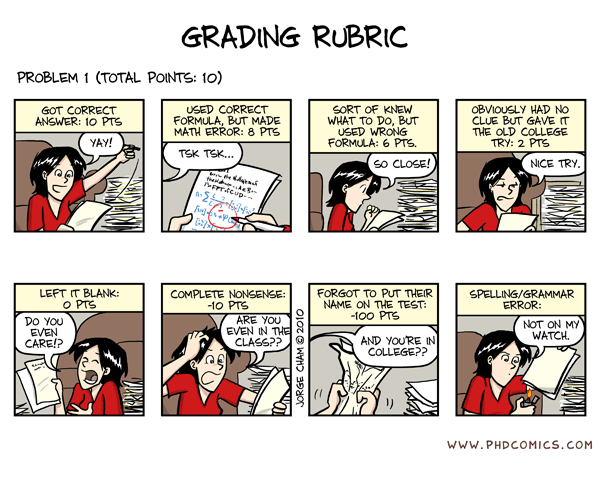
Grading students is a hard task, and if you're a teacher, you know what I mean by this comic... 
Now, if you're a student, here are some requests from all teachers in the world: 
remember your test will be read by someone; when you use that desperately tiny handwriting or  lead that seems to be trying to go unnoticed you're only giving us a hard time understanding what was it that you didn't understand from our classes. 
Trust me - it won't go unnoticed... chances are you'll get a tiny question mark (if yours is one of the first tests on the pile, otherwise it'll be huge as to make up for your disuse of space) and less points than if you had made us understand what you meant.

I'll leave other tips on making exams for later. Gotta go back to my pile now ;-)

*Link gently shared by the dearest friend and co-worker Livia. Thanks, sweetie ;D

Sunday, July 10, 2011


No, you don't need to tell me... You don't need a flawless life plan right away. 
Just think of something meaningful (no matter if it's a goofy meaning, who cares it it's nonsense) and make it happen, NOW!
Pic from the cutest blog Creature Comforts

Sunday, July 3, 2011

The History of English

The History of English in 10 animated minutes (a selection of the best minutes!)


Monday, June 20, 2011

It's about time...


It's about time
It's high time

IT'S ABOUT TIME + SUBJECT + SIMPLE PAST


Monday, June 6, 2011

WORDS THAT DON’T EXIST IN ENGLISH

1.      Waldeinsamkeit (German): the feeling of being alone in the woods
2.      Ilunga (Tshiluba, Congo): a person who is ready to forgive any abuse for the first time, to tolerate it a second time, but never a third time
3.      Litost (Czech): a state of torment created by the sudden sight of one’s own misery
4.      Esprit de l’escalier (French): a witty remark that occurs to you too late, literally on the way down the stairs…
5.      Meraki (Greek): doing something with soul, creativity, or love
6.      Yoko meshi (Japanese): literally ‘a meal eaten sideways’, referring to the peculiar stress induced by speaking a foreign language:
7.      Duende (Spanish): a climactic show of spirit in a performance or work of art, which might be fulfilled in flamenco dancing, or bull-fighting, etc.
8.      Guanxi (Mandarin): in traditional Chinese society, you would build up goodguanxi by giving gifts to people, taking them to dinner, or doing them a favor, but you can also use up your gianxi by asking for a favor to be repaid.
9.      Pochemuchka (Russian): a person who asks a lot of questions
10.  Selathirupavar (Tamil): a word used to define a certain type of absence without official leave in face of duty
11.  Gheegle: (Filipino) The urge to pinch or squeeze something that is unbearably cute.
12.  Cualacino: (Italian) The mark left on a table by a cold glass.
13.  Sgriob: (Gaelic) The itchiness that overcomes the upper lip just before taking a sip of whisky
14.  Forelsket: (Norwegian) The euphoria you experience when you are first falling in love.
15.  Pena ajena: (Mexican Spanish) The embarrassment you feel watching someone else’s humiliation.
16.  Arigata-meiwaku: (Japanese) An act someone does for you that you didn’t want to have them do and tried to avoid having them do, but they went ahead anyway, determined to do you a favour, and then things went wrong and caused you a lot of trouble, yet in the end social conventions required you to express gratitude.
17. Saudade: (Portuguese) a deep emotional state of nostalgic longing for something or someone that one was fond of and which is lost.

Saturday, June 4, 2011

The Bilingual Advantage - NYTimes.com

The Bilingual Advantage - NYTimes.com

THE BILINGUAL ADVANTAGE

From The New York Times:

CONV-popupA cognitive neuroscientist, Ellen Bialystok has spent almost 40 years learning about how bilingualism sharpens the mind. Her good news: Among other benefits, the regular use of two languages appears to delay the onset of Alzheimer’s disease symptoms. Dr. Bialystok, 62, a distinguished research professor of psychology at York University in Toronto, was awarded a $100,000 Killam Prize last year for her contributions to social science.

Q. So what exactly did you find on this unexpected road?

A. As we did our research, you could see there was a big difference in the way monolingual and bilingual children processed language. We found that if you gave 5- and 6-year-olds language problems to solve, monolingual and bilingual children knew, pretty much, the same amount of language. But on one question, there was a difference. We asked all the children if a certain illogical sentence was grammatically correct: “Apples grow on noses.” The monolingual children couldn’t answer. They’d say, “That’s silly” and they’d stall. But the bilingual children would say, in their own words, “It’s silly, but it’s grammatically correct.” The bilinguals, we found, manifested a cognitive system with the ability to attend to important information and ignore the less important.

Q. How does this work — do you understand it?

A. Yes. There’s a system in your brain, the executive control system. It’s a general manager. Its job is to keep you focused on what is relevant, while ignoring distractions. It’s what makes it possible for you to hold two different things in your mind at one time and switch between them. If you have two languages and you use them regularly, the way the brain’s networks work is that every time you speak, both languages pop up and the executive control system has to sort through everything and attend to what’s relevant in the moment. Therefore the bilinguals use that system more, and it’s that regular use that makes that system more efficient.

More here